



Marlborough’s two MP ‘s now represented Preshute Parish as well as the Borough of Marlborough. Over half of the new electors lived as tenants of the Ailesbury estate so it was no great surprise when the Ailesbury’s Tory nominees, Lord Bruce and Henry Baring, were returned as MP’s under the re-formed electorate in the General Election of December 1832.
When the Reform Bill had passed in June 1832, the Reformers who had been campaigning for many years, had organised a torchlight procession from the Green to the High Street. There they laid on a dinner for Marlborough’s inhabitants in celebration. The Reformers must have been bitterly disappointed that the two Reform candidates failed to get elected in the December 1832 General Election. During that election campaign there were reports that electors were being intimidated.
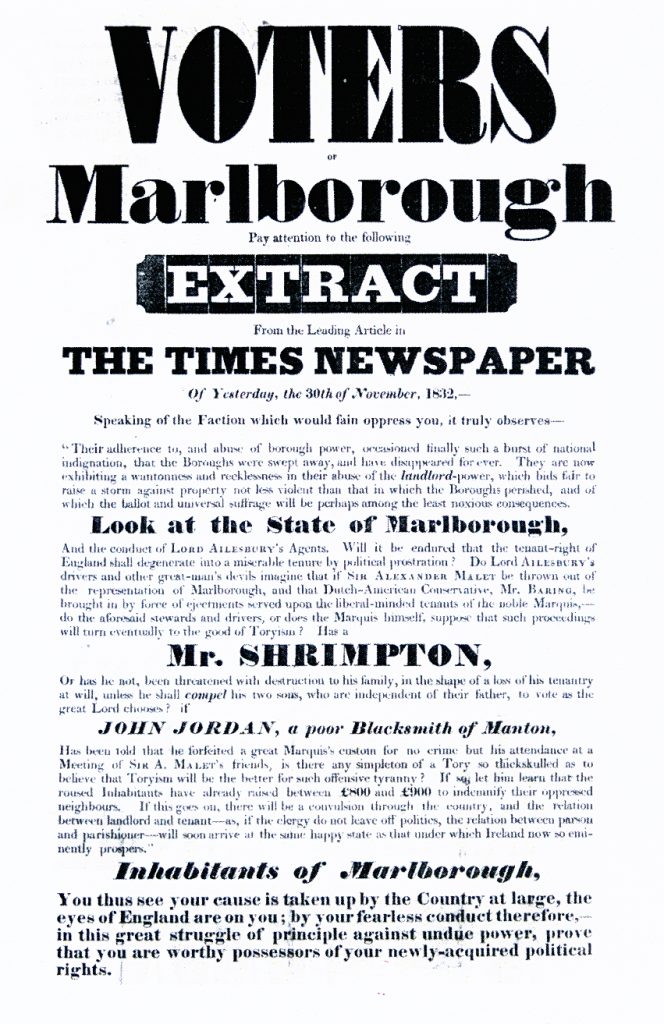 One hundred and thirty electors (almost half the electorate) put their names to a petition to Parliament complaining of intimidation. The Times of London carried an article on the 30th November 1832 alleging intimidation against the Shrimpton family and against John Jordan a poor blacksmith from Manton.
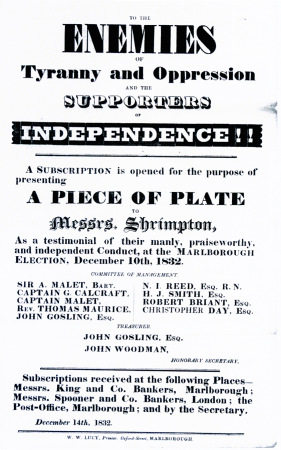
The Shrimpton family in particular must have performed a very difficult balancing act between offending their landlord and supporting their opinions and their many reformer friends. John Shrimpton was the tenant of the Castle Inn2 owned by the Ailesbury family and his son Samuel was a tenant of an Ailesbury farm. They were threat threatened with eviction for not supporting the Ailesbury candidates. In recognition of this courage, the Reform supporters of the Shrimptons presented the family with a piece of plate as a “testimonial of their independent conduct”. At the same time the Shrimptons had been praised for providing a dinner to the Ailesbury controlled Corporation and its supporters.
John Jordan a blacksmith from Manton was threatened with losing the business of the Ailesbury estate because of his attending a meeting of the friends of Sir Alexander Malet who was the Reformer’s Parliamentary candidate.
The era was a time of great social tension. The “Swing Riots” which started in Kent, reached Wiltshire in November 1830. Poor agricultural labourers were protesting at the increasing number of machines on farms which were depressing wages and creating unemployment. Threshing machines in particular were targeted for destruction and mobs of up to five hundred roamed rural areas around Marlborough.
A special meeting at the Town Hall on Saturday November 20th, under the chairmanship of the Mayor, John Gardner, raised £400 for the arrest and conviction of those destroying property. Special constables were sworn in at the Duke’s Arms (later the Ailesbury Arms) and the Marlborough Troop of Wiltshire Yeomanry Cavalry3 was mobilised under the command of a son of the Marquess. The rioting peaked on Tuesday 23rd November when twenty-five Wiltshire towns and villages were affected.
In a riot, Peter Withers of Rockley threw a hammer which injured Special Constable Oliver Codrington and Withers was sentenced to hang. Codrington recovered from his injuries and Withers had his sentence commuted to transportation to Australia.
The situation was under control by Christmas by which time over one hundred threshing machines had been destroyed and one hundred and fifty-three sentenced to transportation.
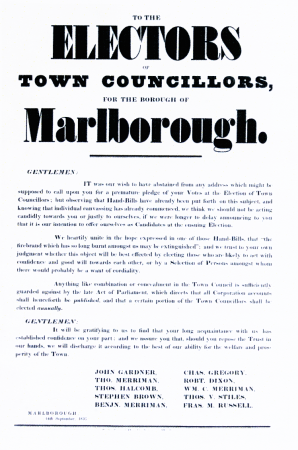
This was the turbulent background to the Reform campaign of the 1820’s and 1830’s and the General Election to Parliament under the new franchise in December 1832. The election under this new franchise returned a House that was strongly Whig and pro-Reform. One of the first actions of this Parliament was to appoint in February 1833 a Royal Commission of The House of Lords to enquire into the Municipal Corporations of England, Wales and Ireland. The Commissioners were Radicals and the two appointed to look at the Marlborough Corporation were Peregrine Bingham and David Jardine. The Commissioners for Marlborough reported.
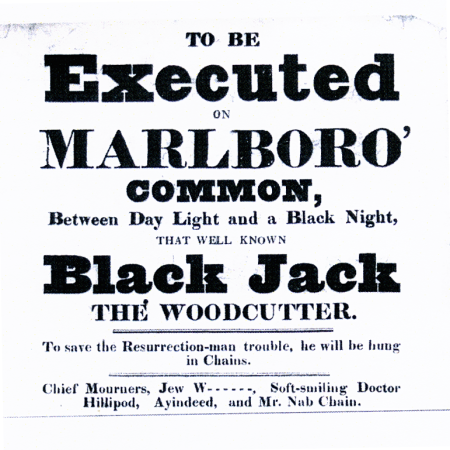
 The venom reached new heights with a leaflet announcing the mock execution of Black Jack on Marlborough Common.